
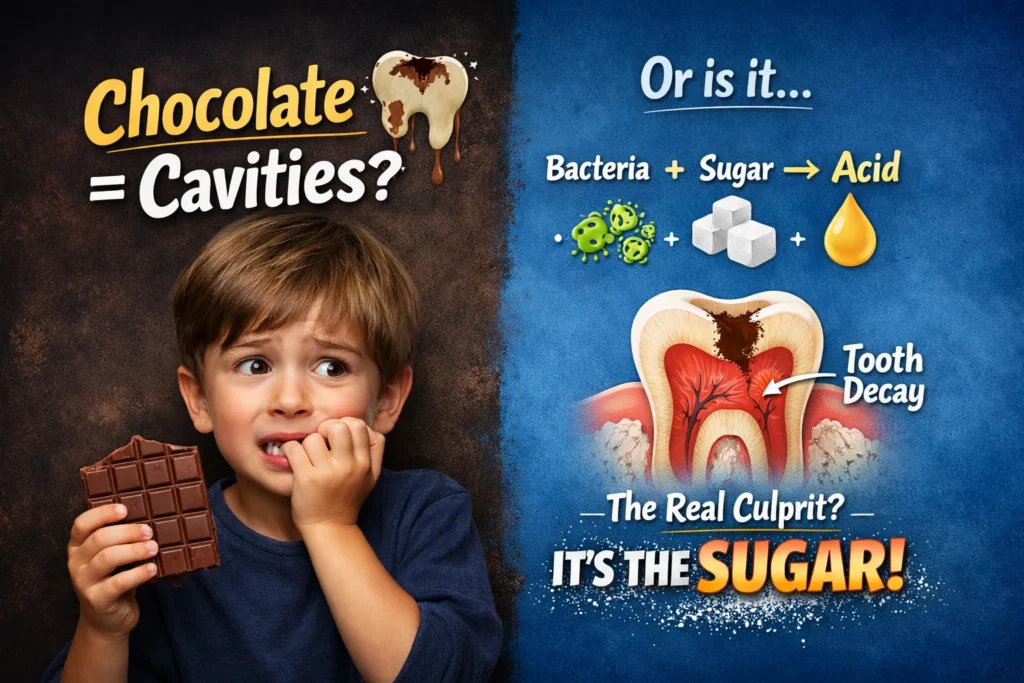
“Chocolate Will Rot Your Teeth” — Or Will It?
“Don’t eat so much chocolate, your teeth will rot.”
For years, chocolate carried the blame for cavities. Sticky, sweet, and irresistible—it was the obvious suspect.
And then came the logic:
Dark chocolate = dark cavities.
It sounded convincing.
But it wasn’t exactly true.
The Real Question We Never Asked
What if chocolate wasn’t the problem at all?
What if we’ve been blaming the wrong thing this entire time?
Because science has been pointing somewhere else for years.
What Actually Causes Cavities? (Backed by Research)
Cavities don’t form just because chocolate sits on your teeth.
They’re the result of a biological process.
According to the World Health Organization, free sugars are the primary dietary cause of dental caries (tooth decay).
Research consistently shows:
- Bacteria in your mouth feed on sugar
- They produce acid as a byproduct
- This acid gradually erodes tooth enamel
A widely cited review on Dental Caries Research highlights that both the amount and frequency of sugar intake directly influence cavity formation.
👉 You can explore the WHO’s findings here:
https://www.who.int/news-room/fact-sheets/detail/sugars-and-dental-caries
👉 And a detailed research review here:
https://pmc.ncbi.nlm.nih.gov/articles/PMC4717883/
So no, cavities don’t come from chocolate itself.
They come from what bacteria do with sugar.
Chocolate vs Sugar: Who’s Actually Guilty?
Let’s break it down.
Chocolate = cocoa + fat + (usually) sugar
Sugar = fuel for acid-producing bacteria
Here’s where it gets interesting:
Studies in oral biology suggest that cocoa may actually have protective properties.
Research published in journals indexed by National Institutes of Health indicates that cocoa compounds can:
- Reduce harmful oral bacteria
- Limit plaque formation
- Potentially protect enamel
👉 Read more here:
https://pmc.ncbi.nlm.nih.gov/articles/PMC10534671/
So technically, the “chocolate” part of chocolate isn’t the villain.
It’s the sugar added to it.
Why Some Chocolates Are Worse Than Others
Not all chocolates behave the same way in your mouth.
Milk chocolates, caramel-filled bars, and sticky sweets:
- Contain higher sugar levels
- Stick to teeth longer
- Prolong acid exposure
According to dental health research, frequency of sugar exposure matters more than quantity—meaning frequent snacking is worse than occasional indulgence.
👉 Supporting study:
https://pmc.ncbi.nlm.nih.gov/articles/PMC3893787/
What About Dark Chocolate?
This is where the myth completely falls apart.
Dark chocolate (high cocoa, low sugar):
- Melts faster
- Sticks less
- Contains beneficial compounds
This makes it a better option for your teeth compared to highly processed, sugary chocolates.
So no—dark chocolate doesn’t give you “black cavities.”
That was just a convenient assumption.
It Was Never About Chocolate
It’s easier to blame something visible.
But cavities are caused by an invisible cycle:
bacteria + sugar + time
Once you understand that, everything shifts.
A Better Way to Think About It
Instead of saying:
“Chocolate is bad for your teeth.”
Say this instead:
“Frequent sugar exposure without proper oral care is.”
Final Bite
Chocolate didn’t deserve the blame it got growing up.
The real culprit was always sugar—and how often we let it linger.
So go ahead, enjoy your chocolate.
Just don’t forget the basics:
- Rinse after eating
- Brush regularly
- Don’t let sugar sit for too long
Because the truth is simple:
It’s not the chocolate. It’s the sugar.