
When Health Problems Become “Normal”
A few days ago, I met one of my paternal aunts after a long time. The first thing I noticed was how visibly bloated she looked. When I asked her if everything was okay, she admitted she had been struggling with thyroid issues. Then came the rest of the list: diabetes, high blood pressure, and several other health complications that have now become a regular part of her life.
What struck me even more was the contrast I saw later that same day.
An 80-Year-Old Who Still Moves Like Life Depends on It
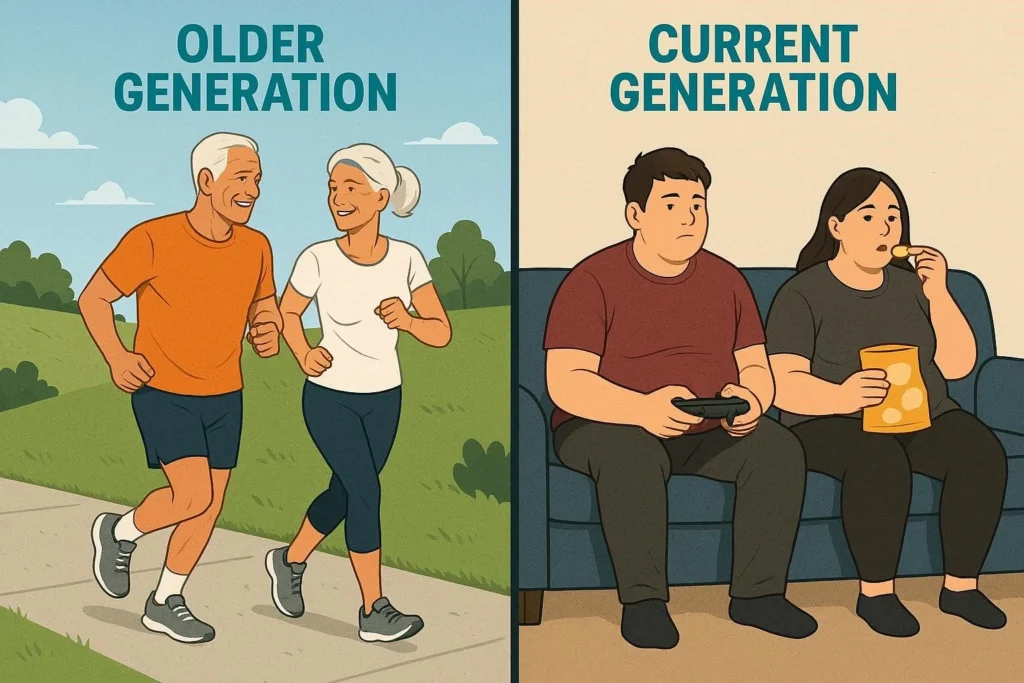
Her father — who is also my grandfather — is now in his 80s. Yet somehow, he looks healthier, stronger, and far more active than many people decades younger than him. He walks properly without assistance, does his daily chores on his own, and still enjoys attending family gatherings with enthusiasm.
And the reason, I believe, is surprisingly simple. He never “worked out” in the modern sense. There were no gyms, fitness influencers, protein shakes, or step counters in his time. But his lifestyle demanded movement.
Before Gyms, Life Itself Was the Workout
My grandfather ran a small business where he regularly dealt with heavy sacks of raw materials. Many of them weighed over 30 kilograms. Sometimes laborers were unavailable, and sometimes he simply preferred to move things himself to speed up the process. Day after day, year after year, he lifted, carried, walked, and stayed physically active without ever calling it exercise.
Back then, it may have looked like he was just trying to save labor costs. Today, his health tells a different story.
The Same Family, Completely Different Health Outcomes
What fascinates me is that the same family that produced such a physically resilient man now has younger generations struggling with lifestyle diseases much earlier in life. One of his sons already has a heart stent. Others live largely sedentary lives. Many barely engage in any meaningful physical activity at all.
Yet when health problems appear, we often blame genetics first. “We inherited it.” Maybe we did inherit certain tendencies. But we also inherited strong bodies capable of movement, adaptation, and resilience. The difference is that previous generations used them daily, while modern life encourages us not to.
Modern Life Rewards Convenience, Not Movement
Today, convenience has replaced movement almost everywhere.
We sit for work.
We order food instead of walking for it.
We take elevators for a two-floor climb.
We spend more time scrolling fitness advice than actually moving our bodies.
Ironically, many people now pay money to recreate the physical strain that older generations got naturally through life and work.
Aging Is Inevitable. Weakness Isn’t.
The saddest part is not aging itself. Aging is inevitable. The sad part is becoming physically old long before actually becoming old.
My grandfather still wakes up early for his morning walks while many younger people struggle to leave their beds before noon. His generation viewed movement as a necessity of life. Ours often treats it as an optional hobby squeezed into busy schedules.
The Inheritance We Ignore
Maybe health is not only about medicine, genetics, or advanced treatments. Maybe the body simply remembers how much we use it. And perhaps that is the real inheritance we choose either to honor or waste.