
Wherever I turn, I see women, mostly healthy-looking, quietly struggling with PCOS/PCOD. A recent large-scale study covering nearly 10,000 women across India found that close to 1 in 5 young Indian women live with this condition, and behind that number are real women navigating irregular cycles, unpredictable weight changes, acne, hair loss, and the emotional toll of a condition that often gets dismissed or misunderstood.
I think it is high time we start making some fundamental changes to our lifestyle. So that the possibility of this disease can be lowered. It has made me think a lot about my own household growing up, because neither my sister nor I have this condition, despite coming from the same family. So, I thought maybe I should share the kind of lifestyle we had that has shaped our health, not as a claim that it’s a cure-all, but as one perspective that might be worth considering. I know it has a genetic linkage, but to be fair, genes load the gun; it is the lifestyle that pulls the trigger.
No Room for Unhealthy Snacks
Growing up, we weren’t from an affluent family, which meant hardly any pocket money to eat out or explore packaged snacks. Even on the rare occasion we did get pocket money, we’d spend it on things we needed for school rather than splurge on snacks. I remember the calculation happening almost automatically in my head — a new notebook or a compass box always won over a packet of chips, not because I was being noble about it, but because that’s just what money was for. Looking back, it wasn’t really a choice we consciously made — it was just how things were. But that lack of choice ended up shaping habits I only now realize were quietly protective.
Unhealthy cravings simply never had the chance to take root in me. Even in college, where I had some generous pocket money, my hand would hardly ever reach for chips, chocolate, or cold drinks. My friends would stock up on all of it between classes, and I’d genuinely watch them with a kind of curious detachment — like I was missing some gene that made those things appealing. I’d sit there, unbothered, while a packet of chips went around the group, and it never once tempted me the way it clearly did everyone else. Instead, I used to feel amazed at how so many people had a liking for that stuff. It wasn’t willpower on my part; the craving itself just never got wired in.
Physical Play Was Just Part of Growing Up
Our evenings revolved around physical games, not mobile phones. Growing up in an area with a lot of kids our age meant we always had people to play with — evenings full of noise and dust and someone always yelling that it wasn’t their turn yet. There was a certain rhythm to it: school would end, homework would get rushed through (or ignored), and by the time the sun started dipping, half the colony would already be outside. Interestingly, none of them were from affluent families either, so we’d make our own makeshift balls out of whatever paper, plastic, and rubber bands we could find, and spend hours playing seven stones (pittu) or just chase — both of which involved a lot of running, falling, scraped knees, and getting called in for dinner far too late.
Even in school, I tried all kinds of sports — running and skipping rope in the lower classes, then cricket, basketball, kabaddi, and kho kho as I grew older. Honestly, there was no structured “exercise” in any of this. It was just what childhood looked like, and our bodies were moving constantly without us ever thinking of it as fitness. Nobody was tracking steps or worrying about screen time; the outdoors was simply the default setting, and stillness was the exception, not the rule.
Simple, Oil-Free Food Was the Default, Not a Diet Choice
Most importantly, oily food was never part of our everyday routine. While most of my friends had parathas and puris for breakfast, we rarely did. Instead, we relied on simple, oil-free breakfast options like upma, idli, and roti — not because we couldn’t afford the alternative, but because we genuinely preferred them, and they were easier to make on a weekday morning when everyone was rushing to get ready. It was food that was quick, filling, and just what we liked, rather than any deliberate health choice.
There was no thought given to calories or nutrients; it was just about what tasted good and got us out the door on time. We didn’t see it as “eating clean” back then; it was just what we had. Looking back now, I realize we were eating in a way people pay good money to be told to eat, except for us it was never a diet — it was just Tuesday. This ties directly into what I shared in how to reduce period cramps — the diet connection runs deeper than most people realize.
Wellness Was Never the Goal — It Was Just How We Lived
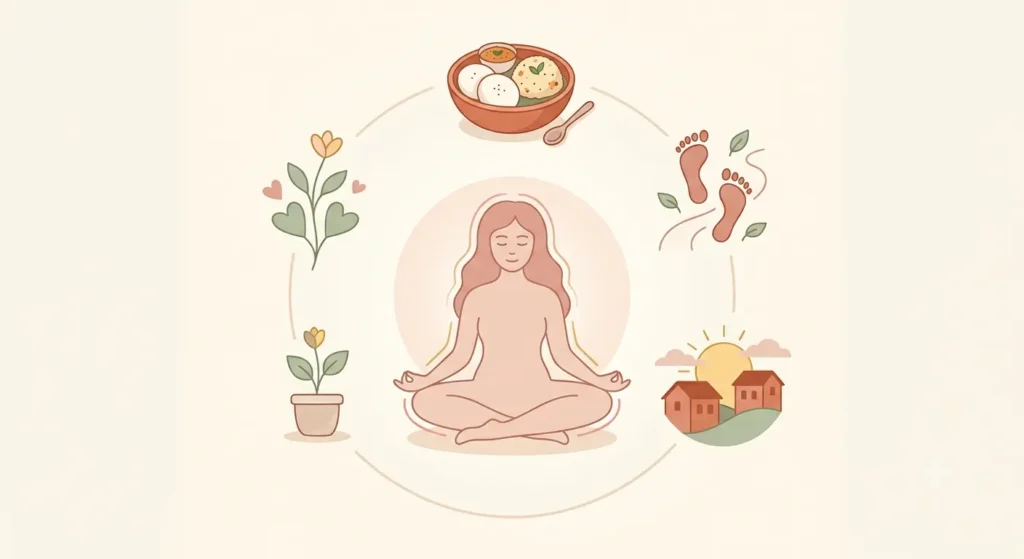
I think these three things are mainly what shaped our health growing up, long before any of us understood the word “lifestyle.” None of it was named or planned; it was just the shape our days took.
It makes me wonder how much of what we now market as “wellness” — clean eating, intentional movement, cutting out processed snacks — was simply the default for a lot of us, not because we set out to live that way, but because that’s just what our circumstances and our tastes happened to add up to. Somewhere along the way, as choices multiplied and conveniences crept in, that default stopped being the default. And maybe that’s the real story here — not that we did something right, but that so much of what protected us was quietly taken away without anyone noticing it was happening.