
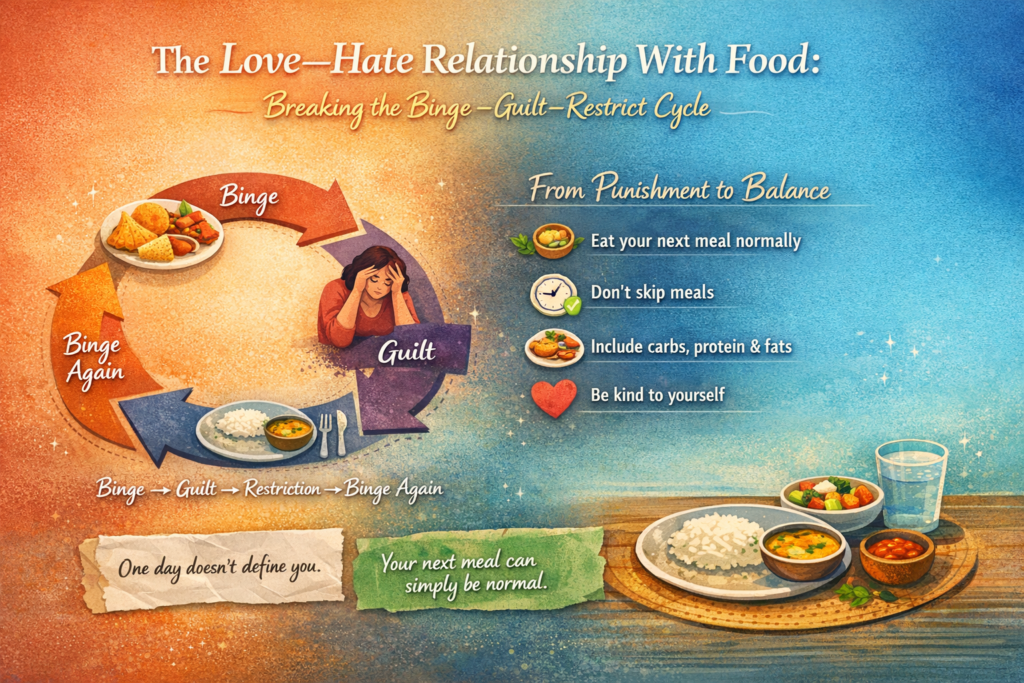
Some days, food feels like comfort, celebration, and joy. Other days, it feels like a loss of control. You eat more than you planned — a kachori here, a samosa there, maybe a full plate of chilli paneer and something sweet on top. And almost immediately, the guilt kicks in.
“Why did I do that?”
“I’ll just fast tomorrow.”
“I need to fix this.”
And just like that, the cycle begins again. Struggling with binge eating followed by guilt and restriction? This blog breaks down the binge–restrict cycle in a simple, relatable way and shows you how to stop it without extreme dieting or punishment. Learn how to build a healthier, more balanced relationship with food.
The Pattern Most People Don’t Realize They’re In
What feels like random behavior is often a predictable loop:
Binge → Guilt → Restriction → Binge
You overeat → you feel bad → you try to compensate by eating less (or not at all) → your body pushes back harder → you overeat again.
It’s not a discipline issue. It’s a biological and psychological response. And the tricky part? The “solution” most people choose — restriction — is actually what fuels the problem.
Why “I’ll Just Starve Tomorrow” Doesn’t Work
After a heavy eating day, the instinct to fast or skip meals feels logical. Like you’re balancing things out. But here’s what really happens:
- Your body senses deprivation
- Hunger hormones increase
- Cravings become stronger and more urgent
- Your mental focus shifts towards food, not away from it
By the time you eat again, it’s not calm or intentional — it’s reactive. And that’s where the next binge begins.
What Actually Helps (Even If It Feels Counterintuitive)
Instead of trying to “correct” your eating, try to stabilize it. After a day of overeating:
- Eat your next meal normally
- Don’t skip meals, even if you’re not very hungry
- Include a mix of carbs, protein, and fats
- Avoid labeling the day as “bad.”
Think of it this way: You don’t need to punish your body. You need to reassure it. Consistency, not control, is what breaks the cycle.
The Guilt Is Louder Than the Food
One day of eating more than usual doesn’t undo your health. But the guilt that follows? That can shape your behavior for days. When you label foods as “bad” or yourself as “undisciplined,” you create a mindset where eating becomes emotional — not just physical. A more helpful reframe:
- You didn’t fail — your body responded
- You didn’t lose control — something triggered a need
- You don’t need to earn food — your body already deserves it
When It’s More Than Just “Overeating”
If this cycle feels familiar and frequent, it may be part of a broader pattern like disordered eating or even binge eating disorder. That doesn’t mean something is “wrong” with you. It means your relationship with food might need support, structure, and a little more compassion than control.
A Question Worth Asking Yourself
Before the binge, what was happening?
- Were you restricting your food earlier?
- Trying to eat “perfectly”?
- Feeling stressed, bored, or overwhelmed?
Because most of the time, the binge isn’t the problem. It’s a response to something that came before.
A Better Way Forward
Not extreme diets. Not punishment. Not starting over every Monday. Just small, steady shifts:
- Eat regularly, even on “bad” days
- Stop swinging between extremes
- Allow all foods, without labeling them
- Pay attention to patterns, not isolated moments
Because healing your relationship with food isn’t about control. It’s about trust. And that starts with one simple decision:
Your next meal doesn’t need to be perfect — it just needs to be normal.